When your car feels “off” on the road, wheel alignment is one of the first things to suspect. Alignment simply refers to the way your wheels are angled and pointed relative to each other and to the car. When it is correct, the car tracks straight, the steering wheel feels natural, and your tires wear evenly. When it is not, the car can feel like it has a mind of its own and your tires may wear out long before they should. Knowing when and why to schedule an alignment can save you money and make driving a lot less tiring.
What Wheel Alignment Actually Adjusts
A modern wheel alignment is about three main angles: toe, camber, and caster. Toe is whether the front of the tires point slightly in toward each other or slightly out, which has a big effect on straight-line stability and tire wear. Camber is the tilt of the tire when viewed from the front, and too much tilt on either side can chew up the inner or outer edge of the tread. Caster is the angle that helps the steering wheel return to center and gives the car a stable feel at speed. When these angles are off, even by a small amount, the car may still be drivable, but it will not feel quite right.
Everyday Signs Your Car May Be Out of Alignment
Most drivers first notice alignment problems during normal driving, not during a special test. The symptoms can start small, then become more obvious as the angles drift farther from where they should be. Some of the most common signs include:
- A steering wheel that sits off-center when you are driving straight
- The car pulling or drifting to one side on a fairly flat road
- Uneven tire wear, especially on the inner or outer edges of the tread
- A light, wandering feel in the steering that makes you constantly correct your path
If you are noticing one or more of these, an alignment check is usually a smart next step. The car may still get you where you are going, but the tires and suspension may be slowly paying the price.
How Does Driving on Bad Alignment Wear Out Tires and Suspension
Misalignment often shows up in the tires first. When the toe setting is off, even slightly, the tire can scrub across the road surface instead of rolling cleanly, and that scrubbing grinds away rubber much faster than normal driving. You might see feathering, cupping, or one shoulder of the tire wearing bald while the rest looks fine. Camber problems can do something similar, putting most of the car’s weight on a narrow strip of the tire.
Over time, the extra vibration and harshness from misaligned wheels can also stress suspension components. Bushings, ball joints, and tie rod ends may develop play sooner because they are constantly being pulled in directions they were not designed to handle. That is one reason we often recommend checking alignment whenever new suspension or steering parts are installed, so everything is working together instead of fighting itself.
When You Should Schedule a Wheel Alignment
There are a few predictable times when an alignment check makes a lot of sense. Any time you replace steering or suspension parts that affect how the wheels are positioned, such as tie rods, control arms, or struts, an alignment should usually follow. The same is true after mounting a new set of tires, because you want those new tires to wear evenly from day one.
It is also smart to consider alignment after a significant pothole hit, curb strike, or minor collision. Even if nothing looks obviously bent, a hard impact can nudge alignment angles out of spec. Beyond that, many drivers benefit from a routine check every year or two, depending on road conditions and mileage. If you are noticing a pull, crooked steering wheel, or odd tire wear, there is no need to wait for a scheduled interval.
How Technicians Perform a Modern Wheel Alignment
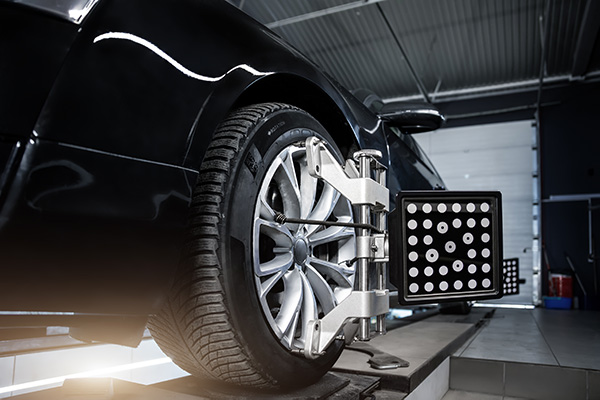
On a modern alignment rack, the car is lifted onto a level platform, and sensors or targets are attached to each wheel. The equipment reads the current angles and compares them to factory specifications for that exact vehicle. Our technicians use those readings to see how far each setting has drifted from the ideal range. From there, they make precise adjustments at the tie rods and, where possible, at camber and caster adjustment points.
Once the adjustments are made, the car is rechecked to confirm that all angles are within spec and that the steering wheel is centered. A proper alignment is not about guessing or just “eyeballing” the wheels; it relies on accurate measurements and small corrections. When everything is dialed in, the car should track straight on a smooth road with the steering wheel level, and the tires should have the best chance at a long, even life.
Cost-Smart Tips to Keep Your Alignment in Good Shape Longer
You cannot control every bump or pothole, but a few habits can reduce how often the car drifts out of alignment. These small changes can stretch the time between alignments and help protect your tires:
- Slow down a bit for rough roads and speed bumps to reduce harsh hits to the suspension
- Avoid straddling deep potholes, and steer around them when it is safe to do so
- Rotate your tires on a regular schedule so you can spot unusual wear early
- Glance at your tires every few weeks, looking for one edge that is wearing faster than the rest
We usually recommend pairing a tire rotation with a quick inspection of the tread and the way the car tracks on a test drive. Catching a mild pull or early wear pattern can mean a simple alignment now instead of a full set of tires sooner than you expected.
Get Wheel Alignment in Buda & Kyle, TX with ME Automotive
We can inspect your tires, suspension, and alignment settings, then let you know if a correction would help your car drive straighter and protect your tires. If something is out of spec, we will explain what we found in plain language and handle the alignment with modern equipment.
We are here to help your car feel stable and predictable on the road, so schedule a wheel alignment visit with ME Automotive in Buda or Kyle, TX, whenever you are ready.