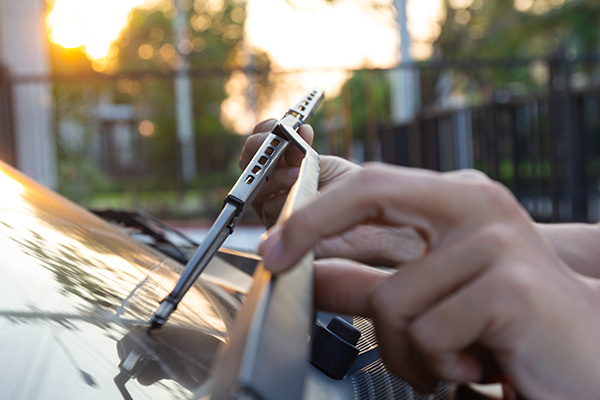
We’ve all had that moment. You’re driving home after a long shift, the sky turns that bruised shade of purple, and suddenly the floodgates open. You flip your wiper switch to high, expecting a clear view, but instead, you get a thump-thump and a windshield that looks like an abstract watercolor painting.
In 2026, with the cost of car ownership hitting record highs and the price of gas making every trip feel more significant, maintaining the "small stuff" is more important than ever. Unfortunately, there’s a lot of bad advice floating around about these humble strips of rubber. Let’s set the record straight on the myths we hear most often at our shop.
Myth 1: "I only need to change them when they start squeaking."
This is probably the biggest mistake we see. While a squeaking or "chattering" wiper is definitely crying out for help, it’s usually the last sign of failure, not the first.
By the time the rubber has hardened enough to squeak, it has likely already lost its flexibility. In a heavy 2026 summer downpour, a hardened blade won’t "hug" the curve of your windshield, leaving dangerous blind spots right in your line of sight.
The Reality: You should be inspecting your blades every six months. If you see "streaking" (small ribbons of water left behind) or "smearing," the edge of the blade is already compromised.
Myth 2: "Cleaning them with a paper towel is enough."
We’ve seen the YouTube hacks suggesting you can just wipe your blades with a dry paper towel to make them like new. Please, don’t do this.
Wiper blades are coated with a special graphite or silicone film that helps them glide smoothly. Using a rough paper towel can actually strip that coating away. Instead, use a soft microfiber cloth and a little bit of soapy water or a dedicated glass cleaner.
Myth 3: "Wiper blades last longer if I don't use them."
Actually, it’s often the opposite. In our neck of the woods, the sun is a much bigger enemy to your wipers than the rain. UV rays and heat can bake the rubber, causing it to crack and become brittle even if you haven't turned your wipers on in months.
If your car sits outside in the sun, those blades are deteriorating every single day. This is why we often see people "fail" their first rainstorm of the season. The sun did the damage while the wipers were sitting idle.
Myth 4: "All wiper blades are basically the same."
Ten years ago, this might have been closer to the truth. But as we move through 2026, the technology has split into three main camps:
- Traditional Frame Blades: These are the ones with the metal frame. They’re affordable but can get clogged with ice or debris.
- Beam Blades: These have no external frame and use a tensioned spring to apply even pressure across the glass. They’re much better for high-speed driving and modern, curved windshields.
- Silicone Blades: The new gold standard. While they cost more upfront, high-quality silicone blades can last 2 to 3 times longer than traditional rubber because they are much more resistant to heat and UV damage.
When Is It Truly Time to Say Goodbye
If you can’t remember the last time you swapped your blades, it’s probably time. But if you want to be scientific about it, look for these "The End" signs:
- Rounded Edges: Look at the wiping edge. It should be sharp and square. If it looks rounded or dull, it won't clear water effectively.
- Cracking or Splitting: Gently pull the rubber away from the frame. If you see any tiny tears or if the rubber has unzipped from the arm, it's a safety hazard.
- The "Haze": If the wipers leave a milky film that disappears after a few seconds, your blades are likely contaminated with oil or road grime that can't be cleaned off.
Wiper Blade Replacement at ME Automotive
Can't remember the last time you had a clear view of the road? Or maybe you’re tired of that annoying chatter every time it drizzles? Stop by ME Automotive in Buda & Kyle, TX this week! We carry a full range of premium beam and silicone blades, and we’ll even install them for you.
Let’s make sure you’re ready for the next storm. Call us now!